When to Start Hypnobirthing: The Two Deadlines Nobody Mentions


Most hypnobirthing courses are designed for the third trimester, and the usual advice is to start somewhere between 25 and 32 weeks. For the labour techniques, that advice holds up. For the rest of it, it is beside the point.
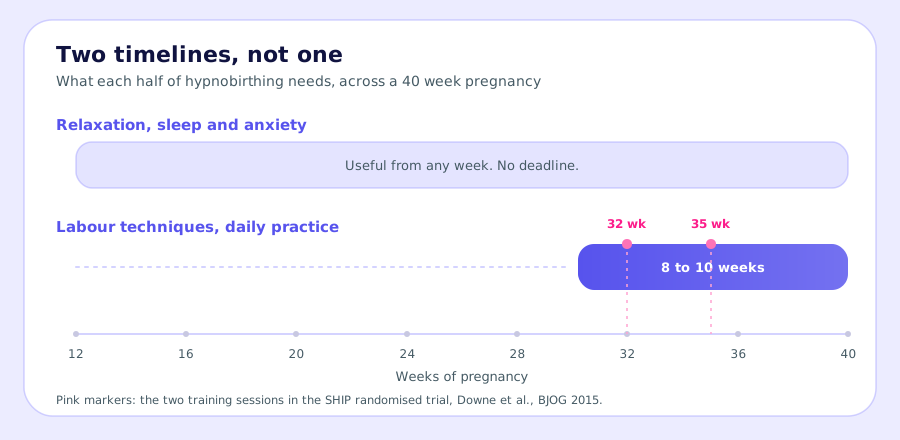
Two fairly different things get bundled under the same word. One is a set of breathing patterns and self hypnosis techniques meant for labour, which need several weeks of daily practice before they do much. The other is guided relaxation, which is aimed at sleep and anxiety and works from whenever you begin. Only the first one has a deadline.
What the courses and the trials actually say
The HypnoBirthing Institute, which runs the original Mongan Method, says most parents begin between 20 and 35 weeks. Its course runs over five weeks, one session of two and a half hours per week, and the Institute states that compressing it is not recommended, because parents need the gaps to practise.
The most precise numbers come from a clinical trial. In the SHIP trial, run across three NHS hospitals in England, women were given two ninety minute self hypnosis training sessions at around 32 and 35 weeks of pregnancy, together with a 25 minute audio track they were asked to listen to daily until the birth. That is roughly seven to ten weeks of daily practice by the time labour starts.
If you want a single target for the labour side, 25 to 32 weeks is consistent with both.
Worth noting what those two sources have in common. Neither of them treats the teaching as the intervention. The Institute spaces its sessions a week apart specifically so that practice happens in between, and the trial handed every participant a daily audio track and asked them to use it for the remaining weeks of the pregnancy. The course is the smaller half of the time commitment.
Why the labour techniques need weeks
What you are training is a response, not a piece of knowledge. Reading about a breathing pattern takes ten minutes. Getting your body to follow it while you are tired, uncomfortable and somewhere unfamiliar takes repetition, and repetition takes calendar time rather than effort.
The women in the SHIP trial were interviewed afterwards, and most of them said two training sessions had not been enough. Several asked for a third, closer to their due date. They were not asking for more explanation.
The same study contains a practical argument against leaving it late: three participants never reached the second session, because they went into labour first.
On what the technique buys you, the honest answer is modest. The 2016 Cochrane review pooled nine trials covering 2,954 women. Women using hypnosis were less likely to use pain relief medication overall, with a risk ratio of 0.73, and there was no difference in epidural use between groups. The reviewers graded all of that as low quality evidence and said better trials were needed. So it is worth doing, on current evidence, and it is not a guarantee of anything. If you are weighing it against a taught course, we compared what hypnobirthing costs separately.
Sleep and anxiety do not wait for the third trimester
The relaxation side of hypnobirthing addresses problems that show up much earlier in pregnancy, which is why the timing question has a second answer.
Sleep is the clearest case. A 2021 meta analysis of ten studies covering 8,798 women put the pooled prevalence of insomnia in the third trimester at 42.4 percent. One of the studies it cites followed women across the whole pregnancy and reported 44.2 percent in the first trimester, 46.3 percent in the second and 63.7 percent in the third. Another estimate in the same review has early pregnancy between 12 and 38 percent.
Those numbers disagree with each other by a wide margin, because they use different questionnaires and different thresholds. Read them as a range rather than a measurement. What they agree on is that a substantial minority of women are sleeping badly well before the third trimester.

Anxiety is harder to argue from evidence. Trials of relaxation and mindfulness programmes in pregnancy are mostly small. The MindBabyBody pilot, run in an Australian maternity hospital, enrolled women between 10 and 34 weeks for six weekly sessions. Women in the programme reported improvements in their own anxiety scores, but in the randomised part of the study there was no difference between the intervention group and women receiving usual care. The authors described it as a feasibility study and called for larger trials.
So the case for starting early is not that it improves your birth. Nobody has shown that, and the people claiming it are going beyond their evidence. The case is that the relaxation material addresses something that is already happening, and it costs you nothing to use it in the meantime.
There is a secondary argument, which is that you are not starting from nothing at 34 weeks. If listening to something at night is already part of your routine, adding the labour material later is a change of content rather than a new habit. That is an argument from plausibility, not from data.
Starting at different points in pregnancy
Before 20 weeks. Uncommon but not unusual. On one Mumsnet thread about course timing, replies included women who had started at 16 weeks and at around 18 weeks, one of whom had rewatched the modules several times. If the first trimester has left you exhausted and nauseous, there is no reason to work through structured material. Use the relaxations for sleep and come back to the rest.
20 to 28 weeks. Comfortable. You have time to practise without counting down, and you are generally not yet uncomfortable at night. On that same thread, a course instructor suggested 25 weeks as a good point to begin, and one woman who started at around seven months said she practised daily and used the techniques when her labour did not go as planned.
28 to 34 weeks. This is the window the SHIP trial itself used. It works, but daily practice stops being optional.
34 weeks and later. A woman posting at 32 weeks, anxious after a difficult first birth, asked whether she had left it too late. The replies were unanimous that she had not. Several noted that hypnobirthing audio tracks are commonly sold as suitable from 32 weeks to birth. One reply described listening nightly for about four weeks; another had started at 34 weeks with a single CD.
Those are two forum threads and perhaps a dozen people between them. They tell you what is common and what is possible. They do not tell you what works best, and nobody has run that trial.
If you are starting late, the practical advice from those threads is to narrow the scope: one breathing technique and one track, used every day, rather than a full course you will not finish.
Reasons to start earlier than you planned
A previous birth that frightened you is the strongest one. You are not only learning a technique, you are working against a memory, and several weeks of audio is a different proposition from several weeks of audio plus unpicking what happened last time. The woman posting at 32 weeks was in exactly that position, and she was already anxious about the time she had left.
A planned caesarean or a booked induction changes what you are preparing for rather than whether it is worth it. In both cases you know the date, which makes it easier to work backwards, and there is little reason to wait.
Twins, or any reason to expect an early arrival, brings the whole schedule forward. Three women in the SHIP trial went into labour before their second training session at 35 weeks.
A second or third baby without a difficult history is the one case that arguably needs less time, not more. You know what labour feels like, and the part most first time mothers spend weeks on, which is imagining something they have never experienced, is not where your preparation goes. That said, none of the trials separated first time mothers from the rest in a way that would let anyone put a number on it. The SHIP trial recruited only nulliparous women, so its seven to ten week figure describes first births specifically.
There is also a scheduling reality that has nothing to do with evidence. If you are booking a live course rather than using an app, the places fill, and a partner who needs to take time off work needs notice. Both of those push you towards deciding earlier than the technique itself requires.
A schedule that survives real life
From the second trimester, ten or fifteen minutes at night is enough, using the sleep and relaxation material. You are building the habit, and getting some sleep.
From around eight weeks before your due date, add the breathing and do it every day. Frequency matters more than session length here.
In the last three weeks, practise with whoever will be with you. Agree what they will say, who talks to the midwives, and what goes on when you arrive.
One thing worth knowing: if you fall asleep every time you listen, you are listening at the wrong time of day. Lying down at bedtime cues sleep rather than focus, which is fine for the sleep tracks and no use for the labour practice. Sit up, and do those earlier.
If you want one number to work from, 28 weeks leaves room for both timelines. If you are already past it, the threads above suggest starting now with one track matters more than which week you are in.
Sources
- HypnoBirthing Institute, Frequently asked questions
- Downe S. et al., Self hypnosis for intrapartum pain management in pregnant nulliparous women: a randomised controlled trial of clinical effectiveness, BJOG, 2015
- Finlayson K. et al., Unexpected consequences: women's experiences of a self hypnosis intervention to help with pain relief during labour, BMC Pregnancy and Childbirth, 2015
- Madden K. et al., Hypnosis for pain management during labour and childbirth, Cochrane Database of Systematic Reviews, 2016
- A systematic review and meta analysis of prevalence of insomnia in the third trimester of pregnancy, BMC Pregnancy and Childbirth, 2021
- Woolhouse H. et al., Antenatal mindfulness intervention to reduce depression, anxiety and stress: a pilot randomised controlled trial of the MindBabyBody program, BMC Pregnancy and Childbirth, 2014
- Mumsnet, 32 weeks, too late to start hypnobirthing?
- Mumsnet, When did you start doing your hypnobirthing course?
Prepare for a calm, confident birth
The Blessed hypnobirthing app gives you hypnobirthing programs, guided meditations, sleep stories, and a contraction coach – all in one place.